
At Van Buren Local Schools, our mission is clear: we build thinkers, experiences, and connections. While our classrooms are the heart of this work, our financial stability is the foundation that makes it possible. In line with our finances strategic pillar, we are pleased to highlight our five-year forecast update showing how we are managing resources efficiently to provide a high-quality education for every student in our district.
No Debt = More Money Supporting Students
Our goal is always to identify opportunities to increase services while reducing costs. Something that helps us direct as much money as possible toward supporting the achievement of our students is that we do not have any debt as a school district. That means the money we receive stays here instead of going to a bank as an interest payment.
By controlling spending, we are not contributing to the over $500 million dollars Ohio schools are paying in debt interest every year (as of 2023).(1) That allows us to provide more opportunities to our students, and we are forecasted to avoid deficit spending (when expenditures exceed revenue) through fiscal year 2030, which begins July 1, 2029.
This focus on financial efficiency has also opened up opportunities to improve the experiences of our students, staff, and visitors to our district. In January, it was announced that the high school chiller, which is over 20 years old and at the end of its expected lifespan, will be replaced this spring, and air conditioning will be added to the high school gymnasium this summer (Improvement Projects: HS Chiller Replacement and HS Gymnasium Air Conditioning). This was not an instance of us looking for a way to spend money. It was seeing a need (replacing an aging chiller before it became an emergency) with the added benefit of being an opportunity to add air conditioning to an area of the building used every period of the day for classes and after school for extracurricular events. The chiller replacement and air conditioning will allow both our students during the day and athletes and spectators at events to be in a climate-controlled environment, which will be more safe and enjoyable for everyone involved.
Our transportation department is another example of how we are finding ways to reduce costs while increasing our services. February’s Knight Insight titled “Transportation: Looking at the Numbers and the People Who Make Them Matter” discussed the purchase of a new propane bus costing $155,000. Yes, the cost of any new bus is expensive, but we need reliable buses with up-to-date safety enhancements to transport students every day. Because of the support of our community, we are able to keep our students safe and give them a positive experience before they even arrive at our buildings.
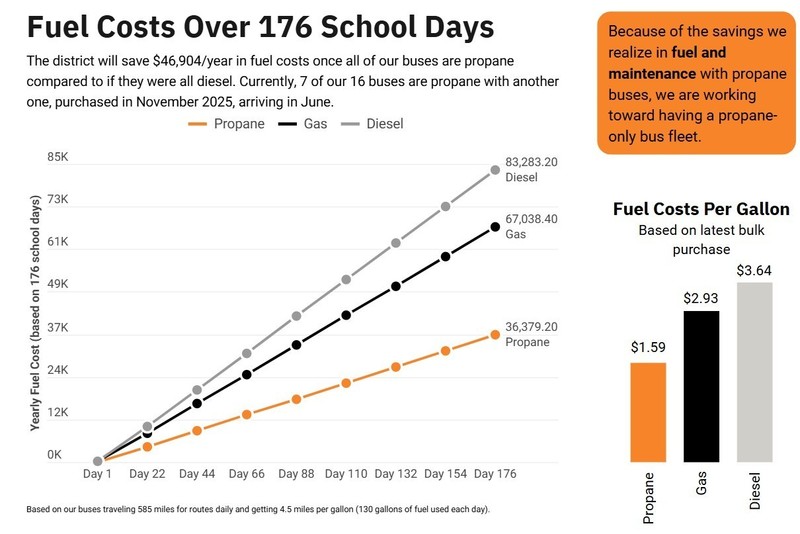
In the course of purchasing our new propane bus, we are trading in a 2007 diesel bus. While it might appear we are simply replacing one bus with another, the chart below shows the impact a propane bus has on reducing fuel costs, not to mention the environmental impact. Once we have only propane buses in our fleet, the yearly savings in fuel will be drastic when compared to what we would be paying if we only had diesel buses.
Navigating a Changing Financial Landscape
While our internal financial management is strong, we are navigating significant shifts in state law. New legislation, particularly HB 186, introduces retroactive property tax caps that create a "double loss" for school districts, meaning we may see a simultaneous decrease in local revenue and state aid.
Additionally, state-level policies over the last 50 years have shifted the tax burden. In 1975, residential and agricultural owners (Class I) paid 46.1% of property taxes our district received; As of 2023, that share has risen to 67.5%, and the burden on Commercial/Industrial (Class II) has been significantly reduced to just 32.5% from 43.9% in 1975.
Our Commitment to Our Black Knights
We believe that being responsible with your tax dollars is the best way to educate students who are respectful, responsible, and resilient. We will continue to monitor everything happening at the state level to determine how we can proactively address potential impacts and continue providing outstanding educational value to our students, families, and district residents.
CLICK HERE to view current and past five-year forecasts and updates.
(1) Thomas B. Fordham Institute. “Capital Outlay and Debt Service.” Ohio Education by the Numbers, 2026, https://www.ohiobythenumbers.com/#school-funding. Accessed 25 March 2026.
Check out what else is happening at Van Buren Local School District:
Seniors Commit to Serving in Armed Forces
Busch and Russell Recognized as Elks Students of the Year
VBSEF Grants: Investing in Our Educators and Students