
Most of the people reading this article have probably known a young child who struggled with articulation, following multistep directions, or organizing thoughts, but these speech and language difficulties sometimes significantly impact a student’s educational experience. That’s where our Speech-Language Pathologist, Ms. Stephanie Danchisen, can step in to empower the voices of our students.
As you might have seen in October’s Knight Insight introducing new staff members, Danchisen joined our district with experience both in grades 1-5 education with Avon Local Schools and the medical sector with Mercy Heath - St. Rita’s Medical Center. She even completed an externship at VB during her own education, which led to her interest in this position. “VB was the model of what I wanted in a job. I wanted the community and support the VB team provides. I loved it when I was here for my externship, and the students are amazing and make me smile every day,” she said.
Director of Student Services Bridgett Bunn, who works with Danchisen extensively, said, “School-based Speech-Language Pathology (SLP) services enhance students’ overall educational experience by addressing communication and language skills that support reading, writing, comprehension, and academic success. By targeting these skills within the educational setting, SLPs help students access the curriculum more fully, engage confidently in learning, and achieve their academic potential.”
Personalized Services for Students
One example of how Danchisen develops these skills is her work with Ms. Brianne Greer’s grades 3-5 cross-categorical classroom. She is able to collaborate with specialists such as occupational therapists, physical therapists, TESOL educators, and others to co-treat students who need to practice skills and speech in an inclusive classroom setting.
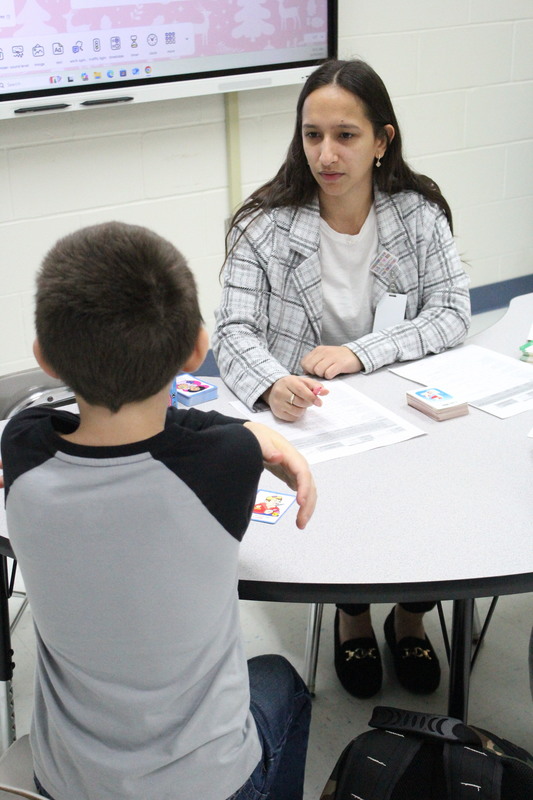
There are also times when Danchisen is working with one or more students in her classroom, but everything comes down to how she can most effectively meet the needs of the students. That even sometimes includes providing caregiver educational resources and guidance that may include obtaining augmentative and alternative communication (AAC) devices that support language accessibility in both school and home environments.
Those AAC devices can be designated communication devices with different types of communication software or communication software on an iPad, which is what Danchisen is currently using with her students with more significant communication needs. She works with them to personalize their AAC device buttons to include core and fringe words helping students communicate overall needs to access their environment, such as “I need help” or “I need to go to the bathroom.” With access to AAC devices, all students have multimodal means of communication to be able to use total communication (e.g., gestures, verbal speech, AAC, American Sign Language, etc).
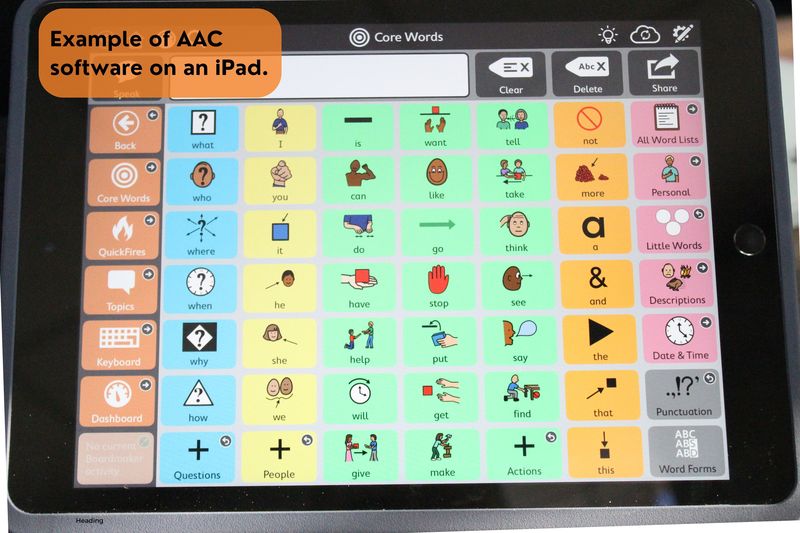
Ms. Sara Ruckman, a middle and high school intervention specialist who has some students utilizing AAC devices in her classroom, said, “Ms. Danchisen does a great job of creating boards that are applicable to students on the AAC devices. Students like to use the devices to tell me what they want, so it is a big win when I can fully understand what they need.”
As a Speech-Language Pathologist, Danchisen is always looking to improve the educational opportunities for her students, so she recently brought in an AAC device representative to work with her and the other district intervention specialists to help them know how these tools can be used most effectively. “After a conversation with our representative, we identified free resources which could help our students, and she is also a resource for us as we continue to use the AAC platform,” she said.
Danchisen is also included in all of the staff meetings, so she knows what is happening district-wide but can also join in collaborations among grade bands to focus more specifically on a group of students. She has worked to create and implement a speech and language support practice into the Multi-Tiered System of Support (MTSS) to determine appropriate levels of intervention and, if needed, support evaluations if the team suspects a disability is playing a role in the educational environment.
Reaching the Goal: Removing Learning Barriers = Optimal Student Growth
Regardless of the processes leading to Danchisen working with a student, all of her students have individualized education plan (IEP) goals they annually work toward achieving with the exception of the intervention services she provides as appropriate to the MTSS model. Educational SLP services strive to optimize student learning by teaching the skills and strategies students need to fully access learning and their educational environment. Every student’s speech journey is unique, with requalification for services being assessed every three years. Based on the triennial evaluation, some students continue to qualify for school-based SLP services, but students who have acquired the skills to exit the program graduate from speech.
“Graduation from speech therapy services is a big step I discuss with students often to help them understand why we are working on the targeted skills and the impact they will have on them reaching their goals. Graduation from services doesn’t mean there are no longer any weaknesses, but those weaknesses no longer warrant specially-designed instruction,” Danchisen said.
With the addition of Ms. Danchisen to our staff, our students who qualify for speech therapy services have increased access to learning and will be able to communicate more effectively throughout their school years and beyond.
Check out what else is happening at Van Buren Local School District:
High Performance, Low Cost: A Look at Our District’s Financial Efficiency
District Receives $20,000 STEM Grant from Pilot Travel Centers
Enhancing Our Student Services
Sign up to receive Knights in the Know